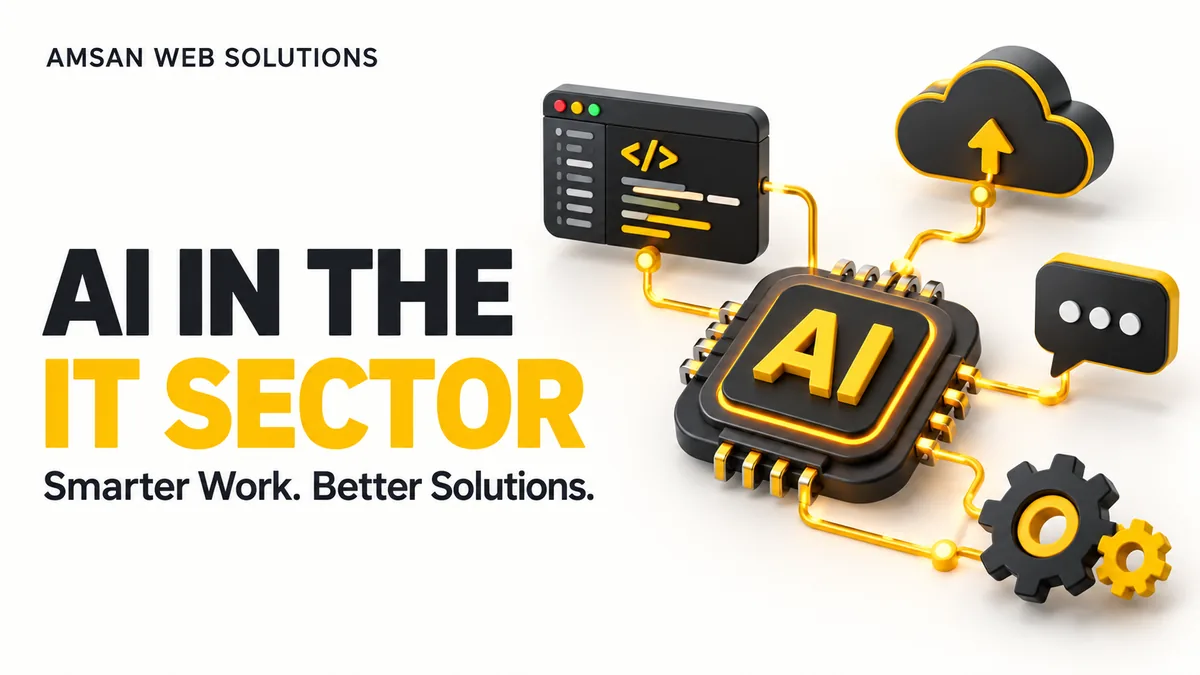
Artificial intelligence is becoming a practical part of everyday IT work. From helping developers write software to making information easier to find, AI can support teams across the planning, development and maintenance of digital systems.
For businesses, its value lies in solving specific problems: reducing repetitive work, supporting customer service and helping employees make better use of information. The results depend on choosing suitable tasks, providing reliable data and reviewing the output.
This article explores how AI is used in the IT sector, where it can help and why human expertise remains essential.
What Is Artificial Intelligence in IT?
Artificial intelligence refers to computer systems that perform tasks involving capabilities such as recognising patterns, interpreting language, generating content and making predictions.
Different types of AI serve different purposes. Machine learning can identify patterns in historical data, while generative AI can produce draft text, code and other content. AI applications can also connect with search systems and software tools to support broader workflows.
Modern IT platforms bring together model development, generative AI applications and agents, along with tools for testing, deployment and monitoring.
How AI Is Helpful in the IT Sector
1. Supporting Software Development
AI coding tools can help developers understand unfamiliar code, explore implementation options and prepare draft changes. They can also assist with documentation and suggest ways to approach a programming task.
For example, a developer working on a website enquiry form might use AI to draft validation logic or explain an error message. The developer then checks the code, tests it and adapts it to the application.
AI is increasingly integrated into development environments, where assistants can inspect code and help complete development tasks. This makes review and testing an important part of the workflow.
Business benefit: Teams can spend less effort on some routine drafting and investigation tasks, leaving more attention for requirements, architecture and quality.
2. Improving Access to Business Information
Finding the right information can take time when documents are spread across different systems. An AI assistant connected to approved sources can help employees search for relevant material and prepare summaries.
A support team, for instance, could use an assistant to locate product instructions or service policies. The application should show where the information came from and recognise when the available sources are insufficient.
AI application platforms support combinations of search, retrieval and chat to make organisational information more accessible.
Business benefit: Employees can find useful information more easily and reduce repeated searches through lengthy documents.
3. Assisting Customer Support
AI can help organise incoming enquiries and prepare responses to common questions. A website assistant could explain published service information, direct a visitor to the appropriate page or collect details for a human follow-up.
Effective support depends on clear instructions and relevant information. Prompt engineering helps define how an assistant responds, including its tone, scope and expected format.
A useful implementation should also make it easy to reach a person. Questions involving exceptions, complaints or unclear information often require human judgement.
Business benefit: Routine enquiries can receive more consistent handling, while support staff focus on issues that need personal attention.
4. Helping With Website Planning and Content
AI can support the early stages of a website project by helping teams organise ideas, draft page outlines and explore alternative wording.
For example, a business could use AI to prepare an initial FAQ structure based on its approved service information. A designer or editor would then check the accuracy, improve the language and ensure that the content reflects the brand.
A detailed prompt can specify the audience, purpose, tone and output format. Providing examples can further clarify what the team expects.
Business benefit: Teams can develop initial content ideas more efficiently and use their review time to improve clarity and relevance.
5. Supporting Testing and Quality Assurance
A practical use of AI is to help a testing team brainstorm scenarios that deserve attention. For an online store, these might include missing delivery details, unsuccessful payments or unusual product quantities.
AI-generated suggestions are starting points. Testers must decide which scenarios apply, carry out the tests and confirm the actual results.
For AI applications themselves, evaluation is also necessary: teams need to check whether responses remain useful and reliable across different inputs. Development platforms include tools for evaluating and debugging these applications before deployment.
Business benefit: AI can support a more structured testing process, while people remain responsible for confirming quality.
6. Assisting IT Operations
IT teams manage systems that produce large amounts of operational data. AI-based approaches can help analyse that information and support the investigation of unusual behaviour.
AIOps applies AI and analytics to IT operations. It can support teams working to understand system activity and manage operational workloads.
An organisation might use this approach to help prioritise alerts or identify patterns that need investigation. The usefulness of the results depends on the quality of the monitoring data and how the system is configured.
Business benefit: Teams can get assistance sorting through operational information and deciding where to focus their attention.
7. Connecting Repetitive Workflows
AI applications can be connected to existing software so that they help with a sequence of tasks. For example, a workflow might summarise an enquiry, assign a category and prepare a draft response for approval.
Agent-based applications extend this idea by allowing models to use tools within defined boundaries. Developers still need to determine what those tools can do, which information they can access and when human approval is required.
Business benefit: Businesses can reduce repeated manual steps while keeping control over important actions.
Where Does Prompt Engineering Fit?
Prompt engineering is the practice of designing and refining instructions for AI models. It is particularly relevant to generative AI applications that produce text or respond to user requests.
A clear prompt explains the task, provides relevant context and defines the desired output. For example:
Summarise this website enquiry in three bullet points. Identify the requested service, the customer’s main goal and any stated deadline. If a detail is missing, mark it as “Not provided”. Do not invent information.
This gives the model a specific task and a clear rule for handling missing details. The output should still be checked before it is used.
Prompt engineering is one part of a complete AI solution. Reliable business applications also require suitable data, integrations, testing, access controls and ongoing maintenance.
Why Human Expertise Still Matters
AI can produce convincing answers that contain mistakes. Generated code may not meet the application’s requirements, and a summary may leave out an important detail.
People provide the business context and judgement needed to assess those results. Developers check functionality, editors verify content and support teams handle situations that require understanding or discretion.
Trustworthy AI development therefore considers reliability, transparency and responsible use alongside technical performance.
A useful working principle is to match the level of review to the consequence of an error. A draft headline needs a different level of oversight from a system that changes customer records.
How Businesses Can Start Using AI
Start with a focused task whose results can be checked easily. Preparing draft enquiry summaries or helping staff search approved documentation can be more manageable than attempting to automate an entire department.
Before introducing a tool, define:
- The problem: Which task takes unnecessary time or effort?
- The expected result: What would a useful output look like?
- The information needed: What data can the system access?
- The review process: Who checks the result?
- The measure of success: Does it improve accuracy, turnaround time or workload?
Run a small trial, record the results and review the errors. Expand the use only when the evidence supports it.
Making AI Useful for Your Business
AI offers practical ways to support software development, customer service, information access and IT operations. Its value comes from how well it fits the work people need to accomplish.
For a business building or improving its online presence, the starting point remains a clear understanding of its customers and goals. AI can support that work when it is introduced with a defined purpose and appropriate oversight.
At Amsan Web Solutions, we focus on thoughtful web design, reliable development and practical digital solutions shaped around your business.
Have a website or development project in mind? Tell us what you want to achieve, and let’s discuss the next step.